

Caries treatment and dental fillings in Riga
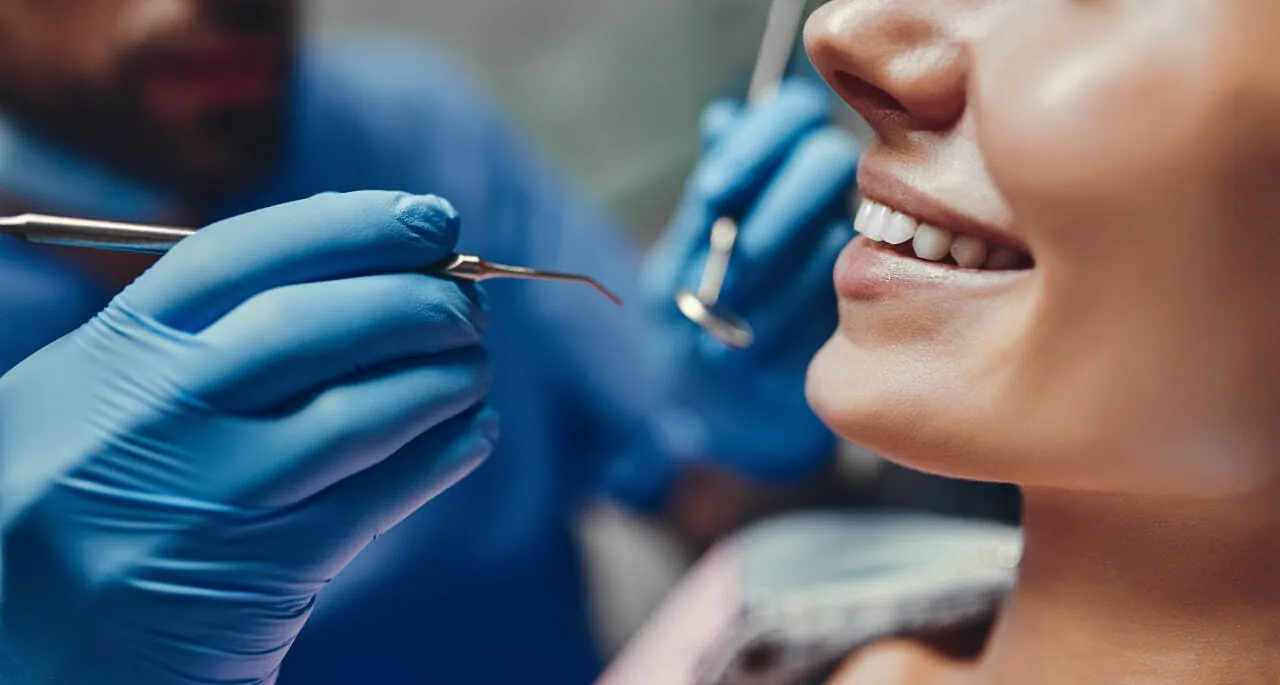
Caries treatment depends on the stage of the damage. If caries is detected early and has affected only the outer layer of the tooth, it can often be stopped with thorough brushing and fluoride-containing care products. If the damage has progressed and a cavity has formed, the tooth is restored with a filling, during which the damaged part of the tooth is filled with a special filling material. However, if caries has reached the tooth nerve, root canal (endodontic) treatment is needed to eliminate the inflammation and preserve the tooth.
Caries and its causes
Tooth damage most often develops in places where plaque accumulates — on interdental surfaces, in the grooves and pits of the chewing surfaces, and in areas near the gums. Plaque is a mixture of chewed food, saliva and microorganisms. During eating, the environment in the mouth turns from alkaline to acidic; under the influence of acids, microorganisms act on food debris, the tooth enamel begins to break down, and cavities form.
State programme
We Care provides free dental treatment for children under 18 years of age within the state programme. Since the scope available under the state programme is limited, there may be a waiting time for an appointment, so we recommend booking in advance.
Modern dentistry WeCare will help you to keep your teeth even in the case of a deep stage of caries
Therapy prices
- Removal of carious masses and temporary closure of the cavity (anesthesia, cofferdam not included) €95
- One tooth surface (small) €120
- Two tooth surface (small) €150
- Three surfaces (vital tooth) €160
- Aesthetic restoration of the front tooth €220
- Surcharge, in case of deep caries €50
- BIODENTINE (covering while maintaining pulp vitality) €85
- White filling on a child's primary tooth €80
- Surface anesthesia €10
- Additional anesthesia €10
- *The prices are informative, they can be changed due to the complications, so it is advised to consult a doctor to clarify the prices.


Frequently asked questions
-
Can a dentist save a badly damaged tooth?
Yes — even when caries has destroyed more than 50% of the tooth tissue, the tooth can often still be saved. In such cases we recommend an onlay: a porcelain restoration made in a laboratory, which is stronger than an ordinary filling and reduces the risk of the tooth fracturing. If the damage is very extensive, a crown may be the answer.
-
What material is used for fillings, and how long does a filling last?
At the We Care clinic we most often use a high-quality composite material for fillings — it allows us to rebuild the shape and colour of the tooth precisely, so the filling looks completely natural. The choice of material depends on the size of the damage and where it is. A composite filling lasts 5–10 years on average; an onlay or a crown lasts longer.
-
What should you do after a filling — what is allowed and what is not?
After a filling placed under anaesthesia we recommend not eating for about two hours, until the anaesthesia has fully worn off — so that you do not injure the soft tissues while your mouth is still numb.
-
Is caries treatment painful?
At our clinic we treat caries under local anaesthesia, so the procedure is painless. Before the injection we apply a topical anaesthetic to reduce any discomfort from the needle.
-
How much does a dental filling cost in Riga?
At the We Care clinic the price of a filling starts from €110 and depends on how deep the caries is and how many tooth surfaces are affected.
-
How dangerous is caries if it is left untreated?
Untreated caries does not go away on its own — it only goes deeper. At first it affects only the enamel, then the dentine, and eventually it reaches the tooth nerve, causing severe pain.
- 32k + visits
- 3500 + prosthetics
- 1000 + implantations
- 96% of patients return to us