

Root Canal Treatment Under a Microscope — Saving “Hopeless” Teeth in Riga
Root canal treatment (endodontics)
Root canal treatment is a procedure that cleans and heals the tooth's canals when the soft tissues, nerves and blood vessels inside them (the tooth pulp) are damaged. Endodontic treatment makes it possible to save even teeth that are recommended for extraction elsewhere, preserving a natural smile and avoiding more expensive and complex procedures in the future.
Tooth diagnosis and the possibilities of the microscope
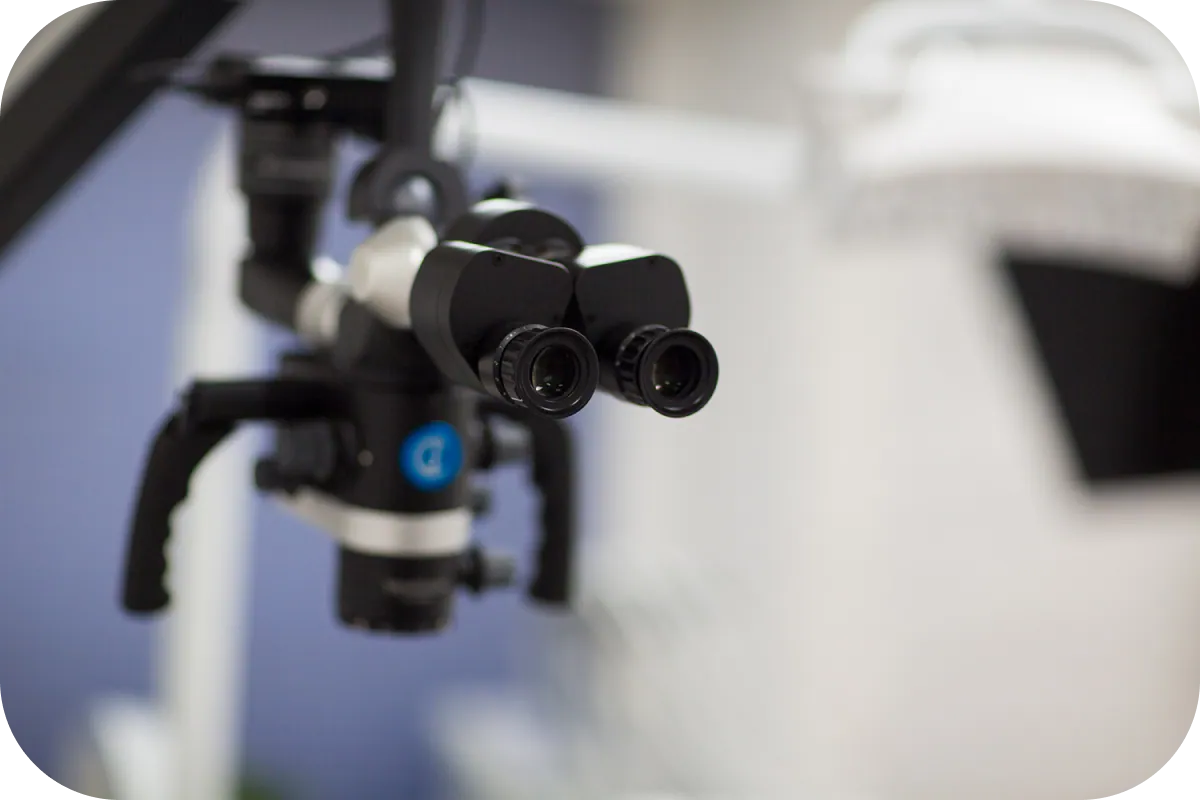
The condition of the tooth is determined through a visual examination and an X-ray. To ensure a precise and long-lasting result, our specialists use a modern dental microscope with up to 25x magnification — this makes it possible to see even the smallest details in the canal structure.
The treatment process
The duration and cost of treatment depend on the severity of the inflammation:
• In simpler cases, treatment can be completed in a single visit.
• If the inflammation has reached the jawbone, two or more visits are required.
The procedure is performed under local anaesthesia. First, the dentist cleans and prepares the root canals for filling, removing the damaged tissue and nerve mass. If the treatment is done in one visit, the canals are filled with gutta-percha right away. If several visits are needed, a temporary filling is placed on the tooth between them. In more severe cases of infection, an antimicrobial medication is placed in the canal before the final filling to eliminate the inflammation.
Don't miss your last opportunity to save a "hopeless" tooth - give it a chance to recover before it becomes impossible.
Endodontic prices
- Preparation of a single canal tooth, filling and sealing from €500
- Preparation of a double canal tooth, filling and sealing from €600
- Preparation of a triple canal tooth, filling and sealing from €650
- Preparation of a four-canal tooth, filling and sealing from €700
- Changing medications between sessions €95
- Canal examination with composite material (if not treated immediately) €250
- Removal of a pin (or foreign body) from the canal €110
- Tooth perforation closure €90
- Sawing/removing a crown or bridge €60
- Surcharge for the degree of complexity (exceeding the time provided for the procedure - every 30 minutes) €60
- *Prices are informative and subject to change
Our specialists who work with the microscope



Frequently asked questions
-
How much does root canal treatment cost in Riga?
At the We Care clinic the price of root canal treatment depends on how many canals the tooth has — treatment of a single-canal tooth starts from €400, a two-canal tooth costs €500 and a three-canal tooth €600. Retreatment costs more, because it is technically more demanding and takes longer. Anaesthesia, X-rays and the restoration that follows treatment — a crown or a filling — are charged separately. The exact price is confirmed after the diagnostics.
-
What should I expect after root canal treatment?
In the first few days after treatment you may feel mild discomfort when biting down — this is normal and usually passes within a few days. An endodontically treated tooth becomes more brittle, as it no longer receives a blood supply and nutrients, so in most cases we recommend fitting a crown to protect the tooth from fracture. Important: after treatment you need regular follow-up X-rays — once every 6 months or once a year, depending on how severe the initial inflammation was.
-
What is the prognosis for root canal treatment, and why is retreatment more complicated?
Endodontic treatment always carries a degree of risk — it is impossible to clear the canals of every last microorganism. The prognosis for initial treatment is better than for retreatment. If a tooth has already been treated elsewhere and the infection has come back, the chances of a successful outcome drop considerably — especially if the previous treatment was of poor quality or apical periodontitis has developed. That is precisely why we always carry out retreatment under a microscope — it allows the problem to be diagnosed more accurately and improves the chances of saving the tooth. Even so, it is important to stay realistic: in some cases even the best retreatment may not deliver a long-term result, and your dentist will explain this honestly during the consultation.
-
How long does root canal treatment take and how many visits are needed?
In simpler cases treatment can be completed in a single visit. If the inflammation has reached the jawbone, or if retreatment is needed, two or more visits are required — between them a medication is placed inside the canal to fight the infection. The procedure is performed under local anaesthesia. Retreatment usually takes longer, because the existing canal filling has to be removed first.
-
Why are root canals treated under a microscope, and does it really make a difference?
The microscope is the single most important tool in high-quality endodontics. It magnifies the image up to 25 times, letting the dentist see canal branches, cracks and errors left by previous treatment that are invisible to the naked eye. Without a microscope the risk of missing a focus of infection is considerably higher — especially in retreatment cases. At our clinic every endodontic case is treated under a microscope.
- 32k + visits
- 3500 + prosthetics
- 1000 + implantations
- 96% of patients return to us