

Oral Surgery and Painless Tooth Extraction in Riga
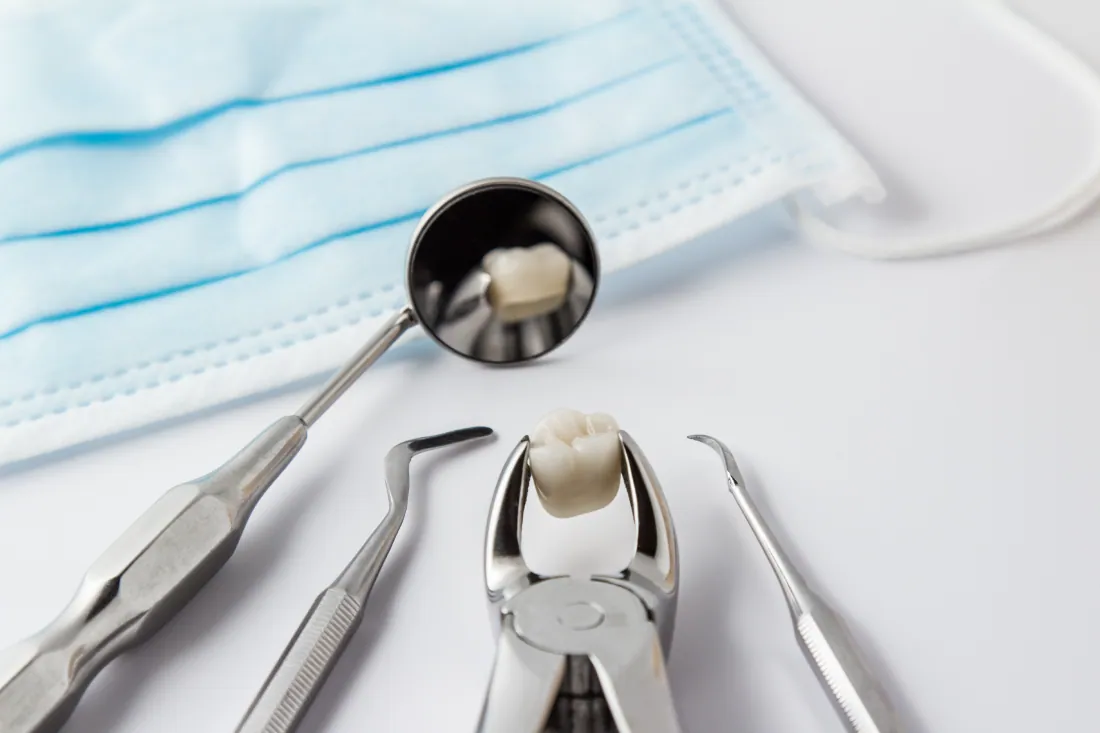
Professional surgical services
In our clinic, we perform extraction of both wisdom teeth and inflamed single-rooted and multi-rooted teeth. It is also possible to remove the remaining roots of a tooth whose crown has been completely lost.
Gentle tooth extraction
When performing an extraction, our specialists pay special attention to preserving the surrounding bone and gum tissue — this is especially important if implantation is planned in the future. A gentle extraction technique reduces tissue trauma, promotes faster wound healing and lessens post-procedure discomfort. Every extraction is carried out under local anaesthesia, ensuring that the patient feels no pain during the procedure.
Gum plasty and preparation for implantation
Sometimes, before implantation or another prosthetic procedure, the gum tissue needs to be corrected to ensure a sufficient and healthy volume of gum around the future implant or crown. If the gum tissue is too thin or insufficient, gum plasty is performed — a procedure in which the gum tissue is repositioned, augmented or reshaped using the patient's own tissue or biological materials. This not only improves the long-term stability of the implant but also provides a more natural and aesthetic result, since healthy gums are an essential foundation for a beautiful smile.
Gum plasty — smile line correction
The smile line is largely influenced not only by the shape and colour of the teeth but also by the contour of the gums. If the gums cover too much of the tooth (a so-called “gummy smile”) or their line is uneven, gum plasty can be used to correct the shape and level of the gums, revealing the teeth in a more proportionate way. The procedure is performed under local anaesthesia and allows a more harmonious and balanced smile to be achieved without altering the teeth themselves.
Stress-free wisdom tooth removal
When should a wisdom tooth be removed?
If a wisdom tooth has erupted, it is prone to infections of the teeth and gums, because it is hard to reach and clean properly with a toothbrush. When damage to a wisdom tooth is found, it is most often extracted, because high-quality treatment is complex, lengthy and expensive, and there is a high probability that the tooth will continue to deteriorate.
How the procedure and recovery go
To remove a wisdom tooth, it is sometimes necessary to open the gum or remove part of the outer bone, after which the wound is sutured. The procedure is performed under local anaesthesia, so afterwards the patient can head home or to work without any particular difficulty.
For the first three days after the procedure, it is advisable to avoid excessive physical exertion. During this time, mild swelling and discomfort are to be expected — it may be harder to fully open the mouth or swallow saliva, and slight bruising on the skin is also possible. To ease recovery, it is recommended to apply an ice pack to the swollen area and to eat light, soft food (such as porridge or kefir). If necessary, the doctor may also prescribe a course of antibiotics.
Simple or complex tooth extraction - get rid of the discomfort of an impacted or misplaced tooth
Surgery prices
- Single root tooth extraction €70
- Double root tooth extraction €110
- Complex extraction (osteotomy, tooth separation) €135
- Wisdom teeth extraction €145
- Surcharge for complex extraction of the 2nd category (osteotomy) €30
- Loose tooth extraction €40
- Surcharge for complex extraction of the 3rd category (osteotomy, tooth furcation) €45
- Loose tooth extraction (child) €30
- Resection of the tooth root tip €260
- Dissection, abscess drainage €45
- Wound treatment after extraction €25
- Suturing €25
- Suture removal €20
- *Prices are informative and subject to change


Frequently asked questions
-
What to expect after a tooth extraction — pain, swelling, recovery?
After a tooth extraction, swelling, mild discomfort and possible bruising on the skin are a normal reaction. Difficulty opening the mouth fully or swallowing saliva during the first few days is also normal. A cold compress on the cheek helps to reduce the swelling. Stick to soft food — porridge, kefir. If the pain does not ease after painkillers, or a fever or an unpleasant smell from the wound appears, contact your dentist.
-
How long do I have to wait after a tooth extraction before an implant can be placed?
As a rule, you need to wait 3–4 months in the lower jaw and 4–5 months in the upper jaw after an extraction for the bone to heal sufficiently. In some cases the implant can be placed immediately after the extraction, during the same visit — this is known as immediate implantation. Your dentist will give a specific recommendation after 3D diagnostics.
-
What should I do and what should I avoid after a tooth extraction?
What to do: Press a gauze pad onto the wound and keep it there for 30–40 minutes; Apply ice to the cheek; You may eat and drink 2–3 hours after the extraction; For 2–3 days after the extraction, avoid anything hot or hard; For pain relief you may take “Ibumetin”, “Ibuprofen” or “Irfen”. Pregnant women may take only “Paracetamol”; Avoid chewing on the side where the wisdom tooth was removed; Eat soft food for the first couple of days; Do not rinse your mouth for the first 24 hours.
What NOT to do for at least 1–2 weeks after the extraction: Smoking — it can slow healing and increase the risk of infection; Sport or other physical activity — it can cause bleeding; Deliberately massaging or touching the site of the extraction wound; Drinking carbonated and fermented drinks — beer, kvass, wine, champagne and so on.
Signs of complications after a wisdom tooth extraction: Severe pain or inflammation that does not subside after taking painkillers; Discharge from the wound with an unpleasant smell or colour; A raised temperature. If you have any of these symptoms, get in touch with us.
-
What should I do if a tooth has already been extracted and there is a gap in its place?
A missing tooth should not be left without a solution — over time the neighbouring teeth begin to shift, the jawbone resorbs and the situation becomes more complicated. The optimal solution is a dental implant, which replaces both the tooth and its root. If implantation is not possible, the alternative is a dental bridge or a denture plate. Book a consultation — we will help you choose the best solution for your particular situation.
-
Is wisdom tooth removal painful?
The procedure is carried out under local anaesthesia, so there is no pain during the extraction itself. Before the injection we apply a surface anaesthetic to reduce discomfort. Once the anaesthesia wears off, there may be mild pain and swelling for 2–4 days — this is managed with painkillers. In complex cases, where the wisdom tooth has grown into the bone, recovery may take a little longer.
-
How much does wisdom tooth removal cost in Riga?
At the We Care clinic, wisdom tooth extraction starts from €145. If the tooth has grown into the bone in a complicated way and an osteotomy or sectioning of the tooth is required, a surcharge applies depending on the complexity category. Please note that anaesthesia and an X-ray or 3D diagnostics are charged separately. The exact price can only be determined after diagnostics, which make it possible to assess the condition of the tooth and plan the procedure.
-
When must a wisdom tooth be removed, and when can it wait?
A wisdom tooth definitely has to be removed if it causes pain, inflammation or recurring foci of infection, if it is growing in the wrong direction and damaging the neighbouring tooth, or if there is not enough room for it and it is partially impacted in the gum. If the wisdom tooth has fully erupted, is in the correct position and is not causing problems, it can be left in place. It is best to consult a dentist and have an X-ray taken in order to assess the situation.
- 32k + visits
- 3500 + prosthetics
- 1000 + implantations
- 96% of patients return to us