

Dental Prosthetics: Crowns, Bridges and Dentures
When prosthetics is used
Prosthetic dentistry is used:
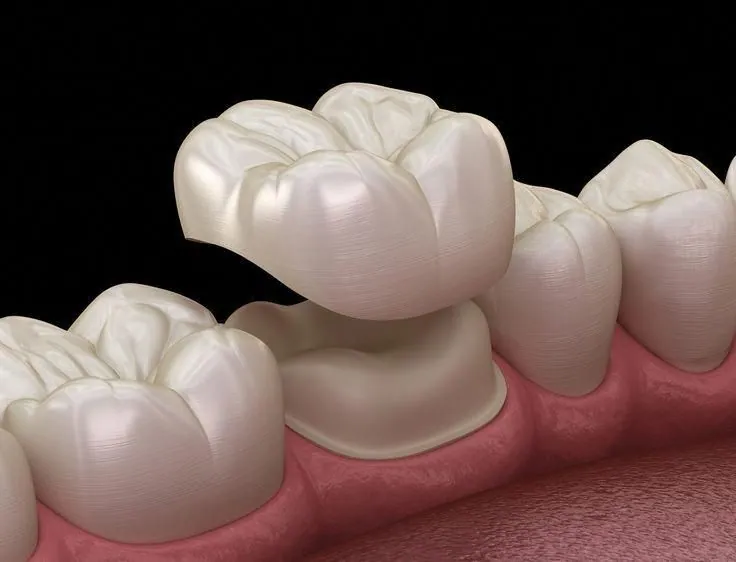
• to restore the damaged crown part of a tooth with an artificial covering — a crown or a veneer;
• to replace a missing tooth with fixed (bridges, implant-supported prostheses) or removable (dental plates) dentures.
The most suitable solution for each case is determined by the dentist, taking into account the extent of the tooth damage, the number of missing teeth and the patient's individual preferences.
Dental plates
Dental plates are a considerably more affordable type of denture, as their fabrication does not require attachment to implants or adjacent teeth. There are two types of dental plates:
Partial dentures
Replace one or several teeth and are held in the mouth by metal clasp fasteners.
Complete dentures
Replace all the teeth of a jaw and stay in place through suction against the mucous membrane of the oral cavity.
Our clinic offers both types of dentures. The fabrication and individual fitting of a denture usually takes two to four appointments. To find out which type of denture suits your particular case, we invite you to first consult with a dentist.
Dental crowns
Dental crowns protect the tooth from further damage and restore its function and appearance. They are used when a tooth has been severely affected by caries, erosion or trauma and can no longer be restored with an ordinary filling. In our clinic, patients can choose crowns made of different materials that differ in price, durability and aesthetic properties — the dentist will help select the most suitable option.
Dental bridges
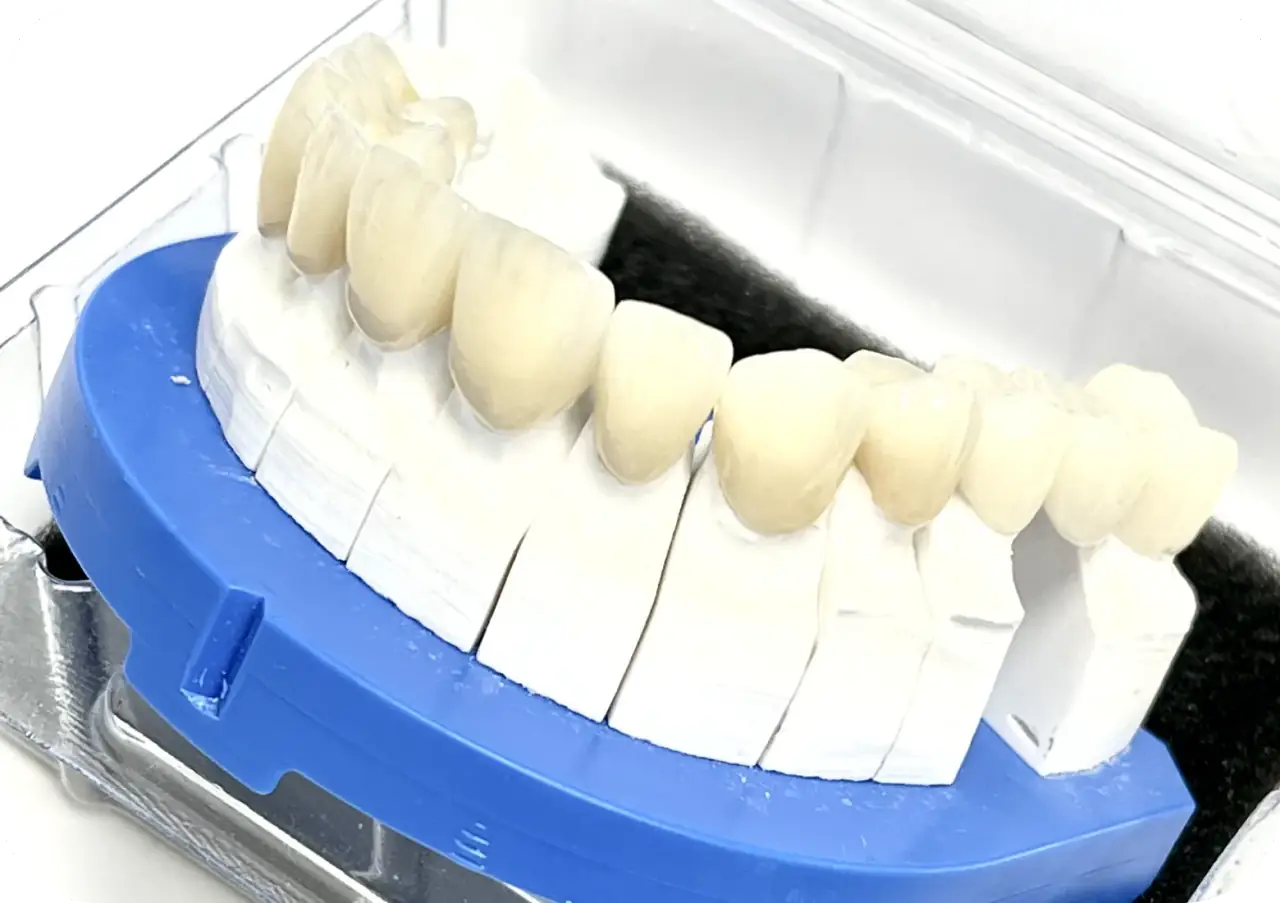
Dental bridges are a fixed prosthetic solution that replaces one or several adjacent missing teeth. Both ends of the bridge are fixed to previously placed implants or to ground-down adjacent teeth, which in the process lose part of their natural tooth tissue. For this very reason, an implant that does not affect the neighbouring healthy teeth is often the preferable solution for replacing a missing tooth.
The dental clinic “We Care” cooperates with several top-quality dental laboratories in Latvia, ensuring precise and durable fabrication of dentures.
State of the art dentures and artificial teeth will become like your own!
Prosthetics prices
- Metal-ceramic crown on the implant €700
- Zirconium crown on the implant €800
- IPS e.max® implant crown with individual abutment €950
- Temporary PMMA (plastic) implant crown without titanium base €250
- Partial regular plastic plate (up to 3 teeth) €500
- Partial regular plastic plate (more than 3 teeth) €650
- Total regular plastic plate €750
- Arc-shaped prosthesis (metal frame with hard plastic) for one jaw €1100
- Arc-shaped prosthesis with milling and attachment for one jaw €1600
- Plastic plate on locators €2500
- Reparation (repair) of the denture €160
- Plastic crown made in the laboratory €170
- Metal-ceramic crown €500
- Resin crown (laboratory) €400
- *Prices are informative and subject to change
- Impression (alginate) €40
- Adding one element to the denture (tooth, brace, etc.) €75
- Muscle relaxant mouthguard for patients with bruxism €400
- Myofunctional visit (mandibular joint treatment) €60
- Night mouth guard (impressions included in price) €130
- Impression to determine the central position of the jaws €50
- Night mouth guard with silicone material €160
- *Prices are informative and subject to change



Frequently asked questions
-
Zirconia, metal-ceramic or all-ceramic crown — which should you choose?
Ceramic crowns look the most natural — they reflect light in the same way as natural teeth, which makes them ideal for front teeth. Metal-ceramic crowns are more hard-wearing and more affordable — a good choice for the back teeth. Zirconia crowns combine both qualities — they are strong and aesthetic at the same time, they do not lose their appearance over the years, they sit closely against the gums and they do not cause allergies. The dentist gives a specific recommendation after an examination, taking into account the position of the tooth and the patient's own preferences.
-
How long do you have to wait after an implant before a crown can be fitted?
After an implant has been placed, you normally need to wait 4–6 months while it fully integrates with the jawbone. Once the dentist has confirmed that integration has been successful, an impression is taken and the permanent crown or bridge is made in the laboratory. For prosthetics on implants, our clinic most often uses zirconia and ceramic constructions.
-
How many appointments are needed to make a denture?
As a rule, 2–4 appointments are needed. At the first appointment the dentist assesses the situation and takes an impression, which is sent to the laboratory. At the following appointments the denture is tried in and adjusted where necessary. With removable dentures the process may take a little longer, depending on the individual situation.
-
How do you look after a denture properly at home?
A removable denture should be taken out at night — this lets the oral mucosa rest and reduces the risk of bacteria building up. Clean the denture with a toothbrush outside the mouth; special denture brushes and pastes can be used. Disinfecting tablets dissolved in water are also recommended. Once the denture is out, clean the mouth itself thoroughly as well — even if none of your own teeth remain.
-
How much does a dental crown cost in Riga?
At the We Care clinic, dental crown prices start from €400 (composite crown) and go up to €950 (IPS e.max crown on an implant with an individual zirconia abutment). A zirconia crown on an implant costs from €800. A temporary plastic crown, used while treatment is under way, is available from €75. The exact price is set after an examination — it depends on the material, the position of the tooth and whether the crown is placed on a natural tooth or on an implant.
-
What is the difference between a dental bridge and an implant?
A dental bridge replaces the missing tooth, but it has to rest on the adjacent teeth — these are ground down and lose some of their own natural tissue. An implant, by contrast, is placed directly into the jawbone and leaves the neighbouring teeth untouched. On top of that, an implant preserves the jawbone and prevents it from resorbing. That is precisely why we primarily recommend an implant as the more worthwhile long-term solution — provided the clinical situation allows it.
-
Why is precise implant placement so important for prosthetics?
Successful prosthetics begin not in the prosthetics surgery but at the implant planning stage. The implant has to sit in exactly the right position, at the right depth and at the right angle — only then will the crown or bridge sit naturally, look aesthetic and function fully. If the implant is placed incorrectly, the prosthesis may be uncomfortable, hard to keep clean or even give an aesthetically unsatisfactory result. That is why our clinic carries out 3D diagnostics before every implant placement and plans the implant position carefully, modelling the end result in advance — first we plan the prosthesis, then we determine where the implant goes.
- 32k + visits
- 3500 + prosthetics
- 1000 + implantations
- 96% of patients return to us